And I get it. I really do. We’ve all been burned by cheap products that looked great in the showroom and fell apart 6 months later. So, the skepticism is understandable.THAT NEVER BREAK But here’s the thing the people saying that have never actually looked at the data. They haven’t looked at who’s buying these vehicles in South Africa, in the Middle East, in Australia, in markets where the roads are brutal, the heat is punishing, and there is no roadside assistance for 200 miles. In those markets, you don’t buy a car that breaks down, you buy a car that doesn’t. And what are people in those markets choosing over and over again? Chinese SUVs.
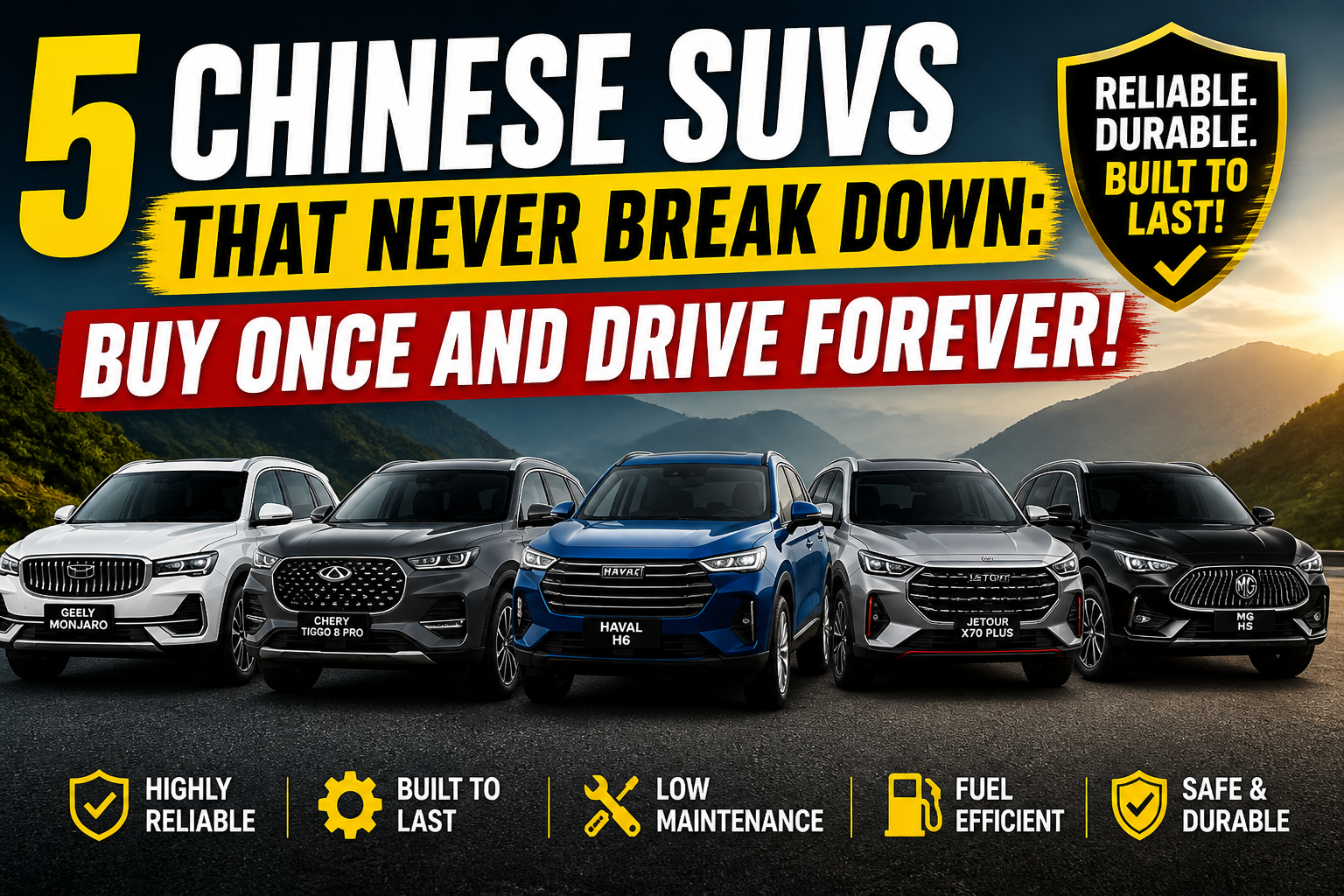
Today on Torque Vision, I’ve done the research. Real owner data, real warranty terms, real sales figures from markets that punish unreliable vehicles with zero mercy. These are the five Chinese SUVs built to last the ones you buy once and drive forever. And by the time we get to number one, I genuinely think you’re going to feel the same kind of low-key betrayal I felt when I put this list together because the world already knows about this car. We just weren’t told. Let’s count it down.
Number five, the GWM Haval Jolen. I know you might be thinking, really, the Jolon for a reliability list? Hear me out because I’m not talking about hype here. I’m talking about receipts. THAT NEVER BREAK The Haval Jolian launched in Australia in 2021. Four years of realworld road data in a country that is not gentle to vehicles. UV radiation that destroys interiors. Pothole rural roads. Salty coastal air.
And in four years of owner reports, you know what keeps coming up as the complaint? The lane keep assist is a bit annoying. The infotainment takes a beat to boot up sometimes. That is it. No engine failures, no transmission collapses, no catastrophic electrical gremlins, electronic niggles on the software side, nothing that leaves you stranded on the side of the road. For a brand that had never sold a single car in Australia before 2015, that is a remarkable track record.
Now, let’s talk about the warranty because this is where GWM puts their money where their mouth is. 7 years unlimited kilome, not 100,000 km, not 150,000 km. Unlimited.
The Toyota RAV 4 gives you 5 years and 100,000 km. The Mazda CX-5 gives you 5 years and unlimited KM. The Volkswagen Tiguan gives you 5 years and unlimited.
GWM says seven years, no cap, no ceiling, no asterisk. That warranty is not a marketing gimmick. It is a statement of engineering confidence. You do not offer unlimited kilometer coverage on a vehicle you’re not sure about. Five-star ANCAP safety rating. one 5 L turbocharged engine in two petrol configurations or a hybrid option. The Jolen starts from around $27,000 drive away in Australia. A Volkswagen Tiguan starts from over $40,000. A Toyota RAV 4 starts from $37,000.
For a compact SUV with a 7-year unlimited warranty and four years of clean Australian reliability data, the Jolen isn’t just a bargain, it’s a statement. Would you buy a Jolian or would you pay $13,000 more for a VW badge? Drop that in the comments.
Let’s go to number four. Number four, the Changen CS75 Plus. Let me give you a piece of information that I think is going to reframe how you look at this car entirely. Changen automobile was founded in 1862.
That is not a typo. 1,862 years before Carl Benz invented the car.
They started as a military arsenal during the Qing dynasty, manufacturing weapons and heavy machinery for the Chinese military. Precision engineering under conditions where failure is not an option. That is the institutional DNA baked into every vehicle they make. And here is the part that kills me. In Chinese, Chang means lasting. An means safety. Changen literally translates to lasting safety. That is not a marketing slogan they came up with recently. That is the name they have carried since the 1800s. I’m not making this up.
Now, here is the engineering proof to back up that name. The CS75 Plus uses an AS automatic transmission. If you don’t recognize that name, let me explain why you should. Azen is the Japanese transmission manufacturer that supplies Toyota, Lexus, and a significant portion of the premium car industry. When Chen needed a gearbox, they went straight to Toyota’s supplier. Think about that. A Chinese car company choosing the same transmission maker as Lexus. Ford and Mazda chose Changan to manufacture their vehicles in China. I want you to sit with that for a second. Ford, arguably the oldest car brand in America, looked at all the manufacturing options in the world’s largest car market and said, “Changen.” If the Blue Oval trusts Chen to build an Explorer, you can trust them to build an SUV.
The CS75 Plus runs a 2 0 L turbocharged engine producing around 233 horsepower. In the UAE, real owners are selling their Lexus IS-300s to buy this thing. A UAE owner described searching knights on Google for honest reviews before pulling the trigger and after buying it, quote, “I’m sorry in advance,” directed at everyone still overpaying for European alternatives.
In China, the CS75 Plus starts from the equivalent of around $19,000 USD. In the UAE, around $32,000.
The Hyundai Tucson, same segment. Less power starts from $35,000 in that market. The Toyota RAV 4 starts from $38,000.
You’re telling me you’d pay $6,000 to $19,000 more for a car built on a shorter engineering legacy with a less proven gearbox? The math isn’t mathing.
Would you buy the CS75 Plus? I genuinely want to know. Let me know in the comments.
Number three, the Haval H6.
South Africa is one of the most brutal automotive markets on the planet. I mean that literally. Temperatures exceeding 40° C in summer. Corrugated dirt roads that rattle vehicles to pieces. Roads with no markings and no mercy. And fuel quality that isn’t always kind to modern engines. It is the kind of market where vehicles expose themselves. Where the badge means nothing and what’s under the hood means everything.
Haval entered South Africa in 2017, eight years ago. And here is what has happened. In those eight years, the Havl H6 has become one of the bestselling SUVs in the country across multiple model generations in a market that chews up and spits out vehicles that can’t handle the conditions. South Africans do not buy unreliable cars twice. Word travels fast in that community. If the H6 was falling apart, the sales numbers would tell the story. The sales numbers tell a very different story.
And it’s not just South Africa, the Middle East, fleet operators in Saudi Arabia and the UAE running the H6 in temperatures where asphalt goes soft. the kind of operating environment where western fleet managers would spec a Toyota Land Cruiser or a Mitsubishi Pajaro Sport and not look at anything else. These operators are choosing the H6, not because it’s the cheapest option, because it does the job and keeps doing it.
The design itself is no longer the apologetic, well, it’s Chinese kind of styling. Phil Simmons, who made his name at Range Rover, took the creative reigns at Haval’s design studio in 2021. The H6 GT looks like it has no business being as good-looking as it is. Slim LED headlights, aggressive coupe roof line, dual spoilers, a stance that fills the wheel arches properly. From the side, this thing does not look like a budget compromise. It looks like a Challenger.
Under the hood, the two zero liter turbocharged engine delivers 155 kW and 325 Newton me of torque. The H6HEV cuts that down to a 15 L hybrid system producing a combined 179 kW and 530 Newton me. Five-star ANCAP safety rating, class leading warranty package across every market.
And here is the detail that I keep coming back to. Top Gear South Africa wrote after 4,000 km in the H6 HEV. The value offered is undeniable. Coming from a publication that has been driving European cars for decades, that sentence is enormous.
Would the H6 make you think twice about a Toyota RAV 4? because I think it should.
Number two is coming up and this one is built on a completely different philosophy from everything else on this list.
Number two, the GWM Tank 300.
Everything else on this list is a unibody SUV. Modern construction, lots of technology, lots of complexity.
The Tank 300 is something different. It is body onframe. And I know some of you just sat up a little straighter because you know exactly what that means.
Bodyonframe construction means a separate chassis and body.means the mechanical components are not integrated into the structure of the car itself. means if something goes wrong, you can actually get to it and fix it. means the platform has fewer single points of failure than a modern unibody crossover.
It is the same fundamental engineering principle behind the Toyota Land Cruiser. The same principle behind the Mitsubishi Pagarero Sport. The same reason the old Mitsubishi Monto was still running in Mongolia with 300,000 km on the clock. Body on frame does not get old. It does not retire. It keeps going.
Now add this. The petrol version of the tank 300 uses the E20CB engine and an 8-speed ZF automatic transmission.
ZF, the same German gearbox manufacturer supplying BMW, Mercedes-Benz, and Rolls-Royce. When GWM needed to spec a transmission for their most capable off-road vehicle, they did not cut corners. They went to the company that makes gearboxes for the BMW 5 series.
That combination of bodyonframe construction and proven German transmission engineering is not an accident. It is a deliberate statement about what this vehicle is built to do.
Here’s the owner evidence. An Australian buyer, one of the first to take delivery of a tank 300 in 2023, wrote a review at 9 months and 20,000 km. his words, zero issues, whether mechanical or electrical. Zero. He specifically chose the petrol variant over the hybrid precisely because the E20 CB engine and ZF transmission had already been proven in overseas markets.
This is not a guy getting paid to say nice things. This is a bloke who did his research and made a deliberate choice based on proven components.
Now, the price in Australia, the Tank 300 petrol starts from around $51,500 drive away. A Jeep Wrangler genuinely the closest Western comparison in terms of body-on-frame, off-road capability, and size starts from over $70,000. A MercedesBenz Gwagon starts from $270,000.
And I know someone in the comments is going to say the G Wagon isn’t a fair comparison, but here’s the thing. The Tank 300 has twin locking differentials.has low range four-wheel drive. It has a 7-in ground clearance, approach, and departure angles that can handle serious terrain, and a 3,500 kg bra towing capacity. does everything a G Wagon does off-road for a fifth of the price with a ZF gearbox and a 7-year unlimited kilometer warranty.
7 years unlimited kilome for an off-road SUV. GWM sells 3,300 of these in Australia in a single year.
People aren’t buying it blind. They’re buying it because it works.
If your jaw just dropped a little, hit that like button and subscribe to Torque Vision because number one on this list is the one that I want everyone to see because the evidence is so overwhelming, so well documented, and so completely ignored by the Western media that I almost couldn’t believe it when I put it all together.
Number one, the Sher Tigo 8 Pro.
Let me tell you what happened in 2024 in the world of automotive quality measurement.
JD Power, not a Chinese publication, not a brand blog, not a sponsored post, JD Power, the most widely referenced third-party automotive quality research organization on the planet, published their China initial quality study. This study surveys over 31,000 vehicle owners. Real owners, real cars, real data. And when they ranked every Chinese domestic car brand by initial quality score, one brand came out on top. Not BYD, not J, not HL, Sherry. Sherry ranked number one among all Chinese domestic brands for initial quality in 2024. I am not making this up. Dead serious.
But here is the thing about Sherry that I think is the most important part of this story and the part that makes me the most frustrated about how little attention this brand gets in Western media. Sherry has been exporting cars to over 80 countries since 2001, 24 years before BYD was a name anyone in the West had heard. Before the world was paying attention to Chinese automotive exports at all, Sherry was already in South America, already in the Middle East, already in Southeast Asia, already in Africa. Not for a year or two, for two and a half decades across dozens of different markets in climates and road conditions ranging from Saharan heat to Andian altitude to tropical humidity.
That is not a portfolio of vehicles that breaks down. You do not maintain meaningful market presence in 80 countries across 24 years with an unreliable product. The market destroys you if your product fails. The market kept choosing Sherry over and over, year after year.
In 2024 alone, Sherry sold 2.6 million vehicles globally. That is not a niche brand. THAT NEVER BREAK That is a company producing at the scale of Ford’s global output. And every one of those sales is a vote of confidence from a real buyer who decided the Sherry was the right choice.
Now, let me tell you what is happening right now in the United Kingdom because this is where the vindication gets almost embarrassing for the Western automotive press. THAT NEVER BREAK Carwow, one of the most respected automotive review platforms in Britain, named the Sherry Tigo8 their car of the year for 2026.
Their words about the interior, a match for premium cars from Audi and Mercedes.
The Tigo 8 beats a Pojo 508 for this award. It beats the Volkswagen Tron. THAT NEVER BREAK It beats the Kia Sarrento. Western media just handed Sherry the crown and Sherry has been quietly earning it for 24 years while we were looking the other way.
Let’s talk about what you are actually getting. THAT NEVER BREAKThe TGO 8 Pro is a 7 seat family SUV, 4,745 mm long, about the same footprint as a Volkswagen Tiguan Allspace, dual 12 3in curved displays, wireless Apple CarPlay and Android Auto, a fragrance system, ventilated and heated front seats, ambient lighting. A Borg Warner developed all-wheel drive system on the top trim. The two zero L turbocharged engine in the ProMax specification produces around 254 horsepower. Five-star ANCAP safety rating in Australia and the price.
In Australia, the Tigo 8 Pro Max starts from $41,990 drive away. THAT NEVER BREAK A comparable 7 seat Toyota Kuger starts from $56,990. A Kia Sarrento starts from $54,990.
For a car that just won car of the year in the UK, beat Audi and Mercedes in interior quality ratings and carries JD Power’s top ranking for Chinese domestic quality, you are paying $13,000 to $15,000 less than the comparable Japanese and Korean alternatives.
In the UK, the TGO8 PHEV, which takes the ICE engine and adds a 56mm electric range, starts from under $29,000 GBP. A PJO 58 in the same configuration costs $10,000 more. A Kia Sarrento PHEV costs $14,000 more.
Explain to me what those extra thousands are actually buying because the JD Power data doesn’t back it up. The Global Sales data doesn’t back it up. The CarWow Car of the Year award does not back it up. All it backs up is the badge.
We are getting robbed. We have been getting robbed for decades. And Sherry has been quietly out there in 80 countries building reliable, well-engineered vehicles that the rest of the world has been perfectly happy to buy while we were told to stick with the name brands.
24 years of export history. JD Power number one, 2.6 6 million sales in a single year, Carw Wow car of the year, 7-year warranty in the UK, and a starting price that makes the Kia Sarrento look like a luxury purchase.
This is the one. This is number one.
So, there it is. Five Chinese SUVs built to last vehicles with real data, real warranty terms, and real owners in real conditions backing them up. the HL Jolon, the Changan CS75 Plus, the HL H6, the GWM Tank 300, and the Sherry Tigo 8 Pro.
The narrative we’ve been sold about Chinese cars that they look great but fall apart. That narrative is dying. Not because of marketing, because of JD Power data, because of eight years of South African desert driving, because of zero issue Australian owner reports at 20,000 km, because of CarWow handing a Chinese brand the car of the year award in Britain.
The evidence has been building for a long time. The question is whether the Western consumer catches up before they spend another $15,000 for a badge.
If this video changed how you think about Chinese reliability, smash that like button. Subscribe to TorqueVision so you never miss the evidence when it drops. Drop a comment telling me which of these five you would actually buy. And if you want to know which Chinese SUVs are flatout embarrassing the Germans